
12-16-2025
7×24 Exchange Panel Discusses How Data Centers Have Become Misunderstood
By CJ Jorgensen for AZBEX
The largest obstacle facing the development of data centers is communication between developers, municipalities and locals.
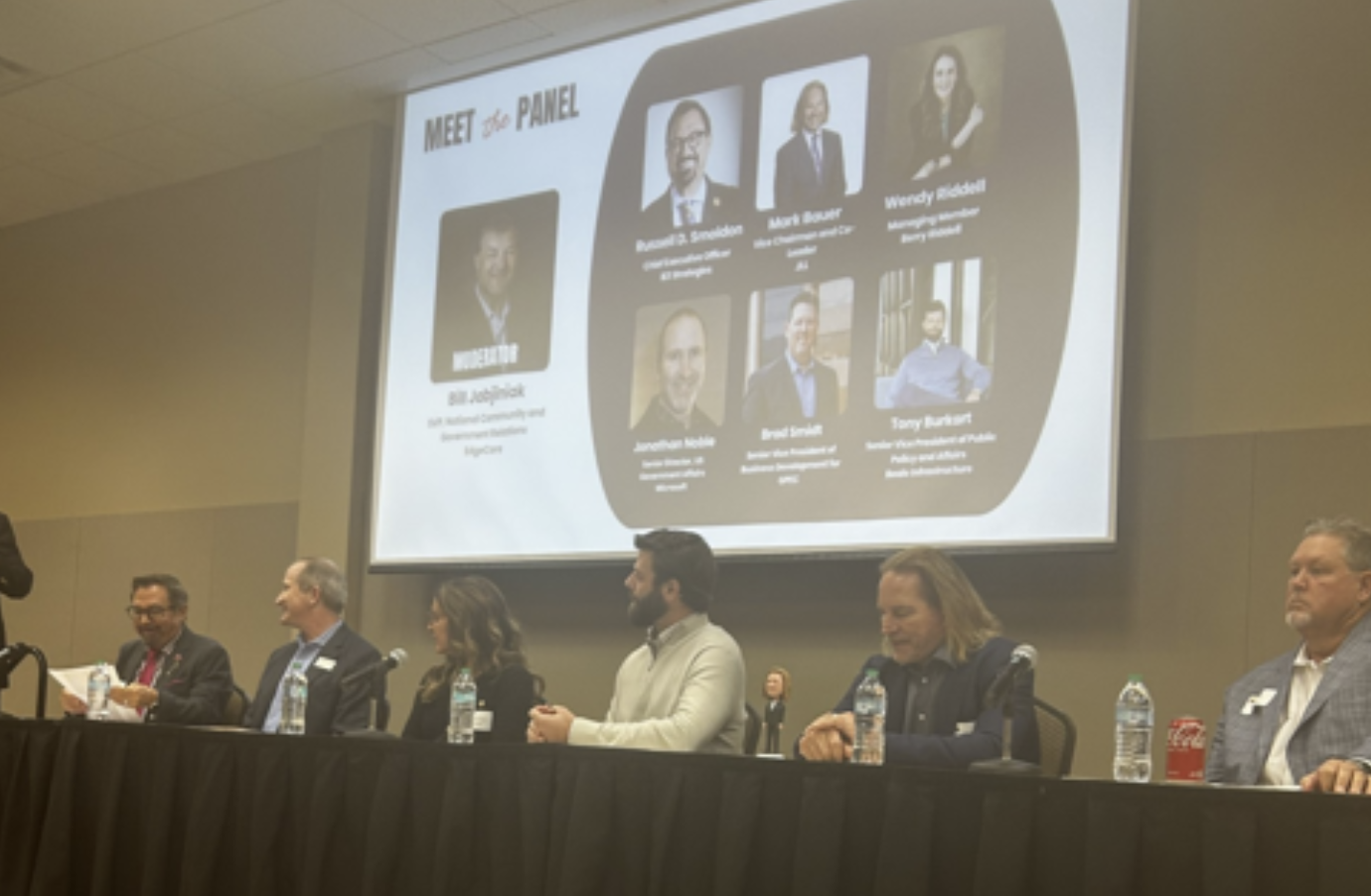
The 7×24 Exchange held its “Building a Better Data Center Brand” panel at the Desert Willow Conference Center on Dec. 10. The six-member panel was assembled to discuss where the data center market in Arizona currently stands, where it is headed and how it has impacted the region.
Senior VP of National Community and Government Relations of EdgeCore, Bill Jabjiniak, moderated the panel. The panelists were:
- B3 Strategies CEO Russell D. Smoldon,
- Berry Riddell Managing Member Wendy Riddell,
- Beale Infrastructure Senior VP of Public Policy and Affairs Tony Burkart,
- GPEC Senior VP of Business Development Brad Schmitt,
- JLL Vice Chairman and Co-Leader Mark Bauer and
- Microsoft Senior Director of U.S. Government Affairs Jonathan Noble.
- Before the meat and potatoes of the luncheon, each panelist was asked to provide a concise hors d’oeuvre describing data centers. Smoldon began by saying data centers are the new utility, to which Noble replied, they are “critical infrastructure for the modern world.”
Riddell agreed, saying data centers serve as the physical manifestation of the digital space. Bauer expressed that data centers have become a sort of expectation, as they are required to live, work and play in the information age.
Burkart and Schmitt were more specific. Burkart zoomed in on the innovations data centers have made possible in the medical field. Every modern medical center is dependent on them. “Data centers keep us healthy,” he said. Schmitt countered with, “I just like watching viral videos.”
Data Center Statistics and Historical Benefit
As of 2023, data centers have created 14,430 direct jobs, according to information provided by Smoldon. Looking at the impact of data centers on macro-scale, the sector has had an employment contribution of 81,730 jobs. This accounts for jobs created indirectly across the state. This is in direct contradiction to the common misconception that data centers do not generate a significant amount of employment opportunities.
The study found data centers resulted in $6.2B for employees. Over the course of the year, the sector had an $11B impact on the Arizona GDP, which is a 5% increase from 2022.
According to Smoldon, there are currently 60 certified data centers in the state.
Why Arizona is a Hot Spot
Arizona’s more urban areas serve as ideal locations for data center development for a variety of reasons. Noble noted Arizona’s ability to accommodate energy and infrastructure needs. Phoenix is also a major U.S. market with proximity to other major markets. Additionally, consumers also benefit from being close to data centers, as it makes load times shorter.
New data center developments commonly run into obstacles from residents and officials, who often say they would prefer the data center to be built elsewhere, somewhere out of sight and out of mind. Riddell said that the data center project entitlement process has become increasingly difficult.
AZBEX has reported extensively on trends and efforts to restrict data center construction around the state. Our coverage is available here.
Many make the claim that data centers do not create many jobs. Riddell countered this by pointing to the statistics supplied by Smoldon, saying data centers do create jobs and economic opportunities; people just have to look in the right place.
As for construction jobs, data centers often undergo additional construction work after the initial construction. This consists of taking out servers, re-racking, HVAC upgrades and more.
Riddell also said companies and data center developers need to be better at advocating for themselves and their products. Jobs are not only created by constructing and operating the initial building. Companies are shifting operations to locations where data centers and development opportunities are plentiful.
During the initial stages of growth in the industry, data centers quietly blended in as industrial projects. This has since changed, which requires a change of approach from developers.
Now that data centers are a hot topic, Riddell said developers may have to do difficult things they would not normally do. “You’re going to have to make commitments on water and power. You’re going to include more trees than you think is rational,” she said.
Riddell pointed out that the controversial discourse surrounding data centers has risen to such an extent that, in a stroke of irony, AI chatbots have advocated against the construction of data centers. AI chatbots, which are reliant on data centers, pull information from several internet sources – such as Facebook, Twitter and Wikipedia.
Bauer added that the rise of controversy is due to a lack of education surrounding what data centers are and how they operate. He said the industry must work toward making the public aware of how the individual benefits from these types of developments.
Burkart distilled the information by saying, “In the absence of telling our story, it will be told for us. And probably not in a good way.”
Noble and Schmitt pleaded with the attendees to spread a positive narrative surrounding data centers to dissolve current misconceptions permeating the cultural zeitgeist.
Negative public opinion about data center developments has resulted in municipalities implementing rules and regulations that are harmful to the industry. Bauer noted each data center is different—they have different purposes, are different sizes and have different needs. Despite this, local governments have tried to put blanket regulations across all data centers that impact some more than others. Smaller data centers are generally more severely impacted by one-size-fits-all restrictions.
Community Impacts
The negative narrative surrounding data centers has created a pervasive idea that the only jobs that data centers provide are high-tech jobs requiring significant education and training.
Schmitt disagreed, saying companies positively impacted by data centers are looking for a broad range of locally based employees with a wide array of education and experience for high-paying positions.
Burkart said Beale Infrastructurehas pledged $15M toward creating workforce development opportunities. He also noted that the construction impact is often overlooked and underestimated. He pointed to the supply chain, asserting data centers and related developments constantly have to be fed from a variety of other businesses across several sectors.
Editor’s note: To catch up on the latest news surrounding Beale’s data center developments, click here.
Burkart added data center developments create a cyclical relationship with developing and attracting skilled tradespeople. He said Columbus, Ohio and Phoenix are two prime examples of regions in which infrastructure and the workforce have benefited from the expansion of the industry.
Smoldon zoomed out and examined the trajectory of Arizona’s economy from the early 2000s. Prior to the Grand Canyon State’s embracing of developing data centers in the 2010s, the economy was primarily housing-based. This led to the state being affected particularly strongly by the housing crash in 2008. The rise of data centers has served as a major tool for diversifying Arizona’s economy, which has prepared it for potential economic crosswinds.
Impact on Utilities
Another common complaint surrounding data centers is their heavy use of power and utilities. Noble agreed that data centers are heavy consumers of, and even reliant on, power. Because of this, he said the industry is the number one supporter of creating a robust and resilient grid at a low cost rate.
Operational costs rise alongside the price of electricity. Therefore, companies benefit from investing in power-related infrastructure. Failures in the power system can have detrimental impacts on data center operations, making it imperative for them to be part of strong grid systems.
Bauer believes utility companies must do a better job showing how infrastructure improvements are paid for. He also commended local utilities for being open to working with and eager to enhance and improve the grid.
Schmitt, somewhat jokingly, said the industry should create “fifth-grade level talking points” to clarify how the utility and data center companies work together.
Burkart added that utility rates function differently from the rest of the economy. As demand increases for utilities, so does the incentive to upgrade systems to make them more cost-effective. Companies are therefore able to, in a sense, subsidize utility costs for themselves and consumers.
He also said he believes that energy costs, except in California, have likely fallen if inflation is taken into account. Smoldon said energy costs are often cyclical; they rise, flatten and fall as new infrastructure is built to maintain the grid.
As far as water use goes, Riddell noted the rapid improvement in technologies has begun to steer data centers away from evaporative cooling systems. Data centers are increasingly likely to use closed HVAC cooling systems, which use significantly less water.
Noble advocated for more communication surrounding water use. He also noted that a large data center uses as much water as a restaurant does on a yearly basis. Significantly higher water use is seen in other sectors, such as manufacturing, agriculture and golf.
Smoldon said Arizona, as a region, has had to become very efficient with its water use, noting that Arizona, overall, uses no more water than it did in 1956.
Innovations in related sectors are rampant. Compact modular nuclear reactors are commonly discussed as a clean and efficient way to power energy-dependent developments. New methods of water purification are being explored daily. Data centers are but another piece of infrastructure that is essential to develop and innovate as the digital age continues.